Dr. Kalpana Chawla
Aerospace engineer born in Karnal, India, who flew twice on NASA's Space Shuttle Columbia and died when it broke up during re-entry on 1 February 2003.
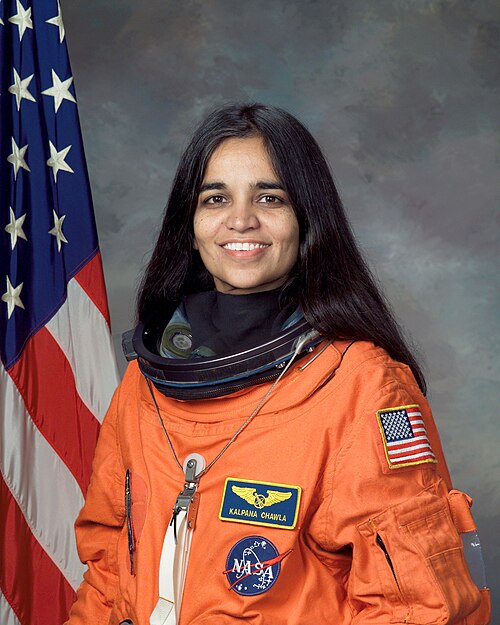

Kalpana Chawla (died 1 February 2003)
Contribution
Chawla flew on two Space Shuttle missions, both on Columbia. On STS-87 (19 November to 5 December 1997) she was a mission specialist and the prime operator of the shuttle's robotic arm. The flight studied how weightlessness affects physical processes and observed the Sun's outer atmosphere. She used the arm to release the Spartan solar satellite, which failed to perform its planned manoeuvre.
On STS-107 (16 January to 1 February 2003) the crew ran about 80 experiments in shifts around the clock. Columbia broke up during re-entry, 16 minutes before its planned landing, and all seven crew members died. Across both flights she spent 30 days, 14 hours and 54 minutes in space.
Career
She finished school at Tagore School, Karnal, in 1976 and earned a bachelor's degree in aeronautical engineering from Punjab Engineering College in 1982. She then took a master's degree at the University of Texas (1984) and a PhD at the University of Colorado (1988), both in aerospace engineering.
She worked at NASA Ames Research Center from 1988 on computational fluid dynamics, then joined Overset Methods Inc. in 1993. NASA selected her as an astronaut in December 1994. She was posthumously awarded the Congressional Space Medal of Honor.
Linked missions
- STS-87, Columbia (1997)
- STS-107, Columbia (2003)