Dr. Vikram Sarabhai
Cosmic-ray physicist from Ahmedabad who started India's space programme; he chaired INCOSPAR from 1962, and ISRO lists him as its head from 1963 to 1971.
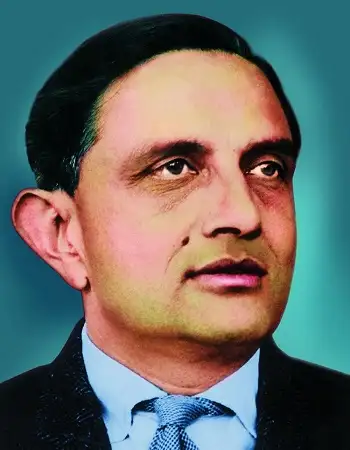

Vikram Ambalal Sarabhai (12 August 1919 – 30 December 1971)
Contribution
Sarabhai's central argument was that a poor country could not afford to ignore space technology. He did not want India to race richer nations to the Moon. He wanted satellites and rockets to work on everyday problems such as communication and education.
With support from Homi Bhabha, he set up India's first rocket launch site at Thumba, near Thiruvananthapuram, chosen partly because it lies close to the equator. The first rocket flew from there on 21 November 1963, carrying a sodium vapour payload.
He also started the project to build an Indian satellite. That work led to Aryabhata, which reached orbit in 1975 on a Soviet launch, four years after his death.
Career
Born in Ahmedabad, Sarabhai studied natural sciences at Cambridge, then researched cosmic rays at the Indian Institute of Science under C. V. Raman during the Second World War. Cambridge awarded him a PhD in 1947.
The same year, on 11 November 1947, he founded the Physical Research Laboratory (PRL) in Ahmedabad. In 1962 he took charge of organising space research in India as Chairman of the Indian National Committee for Space Research (INCOSPAR). He also chaired the Atomic Energy Commission, and helped create IIM Ahmedabad.
He received the Padma Bhushan in 1966 and, after his death, the Padma Vibhushan in 1972. He died at Kovalam, Thiruvananthapuram, on 30 December 1971.
Linked missions
- The Satellite Instructional Television Experiment (SITE) of 1975–76 grew out of his talks with NASA in 1966.
- Vikram Sarabhai Space Centre, ISRO's rocket centre in Thiruvananthapuram, carries his name.
- In 1973 the International Astronomical Union named a crater on the Moon after him.
- The Vikram lander of Chandrayaan-2 was described by the Prime Minister in 2019 as a tribute to him.
Sources
- Dr. Vikram Ambalal Sarabhai (1963-1971) — ISRO
- Dr Vikram Ambalal Sarabhai — Founder — Physical Research Laboratory
- Former Chairmen — ISRO
- Vikram lander will land on Moon as a tribute to Vikram Sarabhai from crores of Indians: PM — PIB