Prof. Satish Dhawan
Aerospace engineer and IISc director who succeeded Sarabhai and ran ISRO from 1972 to 1984; the Sriharikota launch centre is named after him.
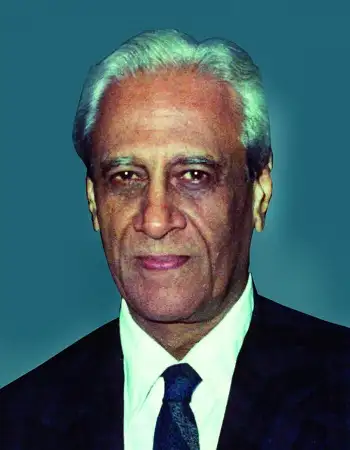

Satish Dhawan (25 September 1920 – 3 January 2002)
Contribution
Dhawan took over ISRO in 1972 after Vikram Sarabhai's death. He also chaired the Space Commission and served as Secretary of the Department of Space.
He pushed early experiments in satellite communication, remote sensing and education by satellite. Those experiments grew into three national systems: the INSAT communication satellites, the IRS remote-sensing satellites and the PSLV rocket.
He was also a working scientist. His research on boundary layers, the thin layer of air that clings to a moving surface, was well known in fluid dynamics. He built India's first supersonic wind tunnel at IISc.
Career
Dhawan was born in Srinagar. He studied in Lahore, then took a master's degree in aeronautical engineering at the University of Minnesota in 1947 and a PhD at Caltech in 1951.
He joined the Indian Institute of Science in Bangalore in 1951, became head of its aeronautics department in 1955 and was its Director from 1962 to 1981. He led ISRO and the Space Commission from 1972 to 1984, and was President of the Indian Academy of Sciences from 1977 to 1979.
He received the Padma Vibhushan. He died in Bangalore on 3 January 2002.
Linked missions
After his death, the launch centre at Sriharikota was renamed the Satish Dhawan Space Centre. The SLV-3 launch that put the Rohini satellite in orbit on 18 July 1980 came during his time as chairman.
Sources
- Prof. Satish Dhawan (1972-1984) — ISRO
- Prof. S. Dhawan — Indian Academy of Sciences
- President condoles the death of Prof. Satish Dhawan — PIB
- A P J Abdul Kalam — PIB profile (SLV-3 launch date) — PIB